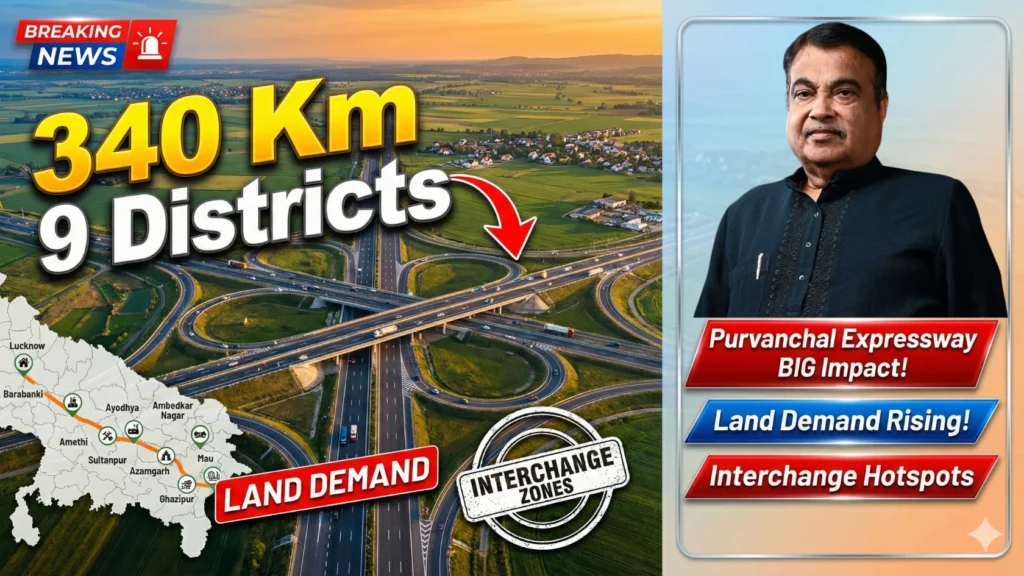
Middle-class investors keep watching the 340.824Km Purvanchal Expressway because it has already turned travel time into “predictable movement,” and predictable movement is what pulls real estate demand. The expressway runs from Chand Sarai (Lucknow) to Haidaria (Ghazipur) and is maintained by UPEIDA, which makes it a long-term backbone corridor, not a temporary project. When investors talk about “land demand building,” they usually mean one thing: new money starts moving toward exits, junctions, and feeder routes where business can actually function.
Design and Build Quality
Purvanchal Expressway is a 6-lane access-controlled corridor (expandable further), and it is designed to move traffic fast with controlled entry/exit. It also has a notable 3.2Km airstrip in Sultanpur for emergency aircraft landings, which shows the expressway was built with strategic planning, not just basic connectivity. For investors, this matters because premium-grade infrastructure typically attracts logistics movement, warehousing interest, and service ecosystems around the corridor.
Also Read: Bajaj Electric Cycle Pro Launch.! 150Km Assist Range, Removable Battery and ₹6000 Down Payment
The 9 District Belt Where Demand Talks Start
The “9 districts” land-demand talk comes from the route belt the expressway influences: Lucknow, Barabanki, Amethi, Sultanpur, Ayodhya, Ambedkar Nagar, Azamgarh, Mau, and Ghazipur. In these districts, the earliest real-estate interest usually shows up around places that have clear access—interchanges, service roads, and nearby highways—because buyers want proof of usable connectivity, not just a map line.
Why Land Demand Builds After an Expressway Goes Operational
Land demand typically builds in phases. First comes headline hype. Then comes the “proof phase” when traffic, toll flow, and travel time savings become routine. After that, business follows—truck movement, roadside services, storage points, small commercial activity, and rental demand for workers. UPEIDA has also talked about industrial corridors along the expressway, and such planning adds to investor attention because it signals long-term economic activity rather than one-time construction.
The Link-Expressway Effect That Pushes New Hot Pockets
A major reason the “effect” keeps growing is connectivity layering. For example, the Gorakhpur Link Expressway connects to Purvanchal Expressway at Salarpur (Azamgarh), expanding the influence belt toward eastern UP and boosting logistics potential. When a corridor becomes a network, new “hot pockets” emerge at junction points because transport and supply chains prefer nodes, not isolated stretches.
Price Movement Logic and Smart Investor Checklist
Investors should treat “land demand talk” carefully because not every village along the route becomes gold overnight. The safest zones are usually 0–3Km from confirmed interchanges with verified approach roads. The risk zones are areas with unclear access, disputed titles, or plot-selling hype without official connectivity proof. A smart middle-class strategy is to track official node announcements, focus on legally clean land, and think in terms of lease potential (warehousing, rentals, roadside services) rather than only resale. That is where expressway-led demand usually becomes real and sustainable.